
لَا أُقْسِمُ بِيَوْمِ الْقِيَامَةِ وَلَا أُقْسِمُ بِالنَّفْسِ اللَّوَّامَةِ
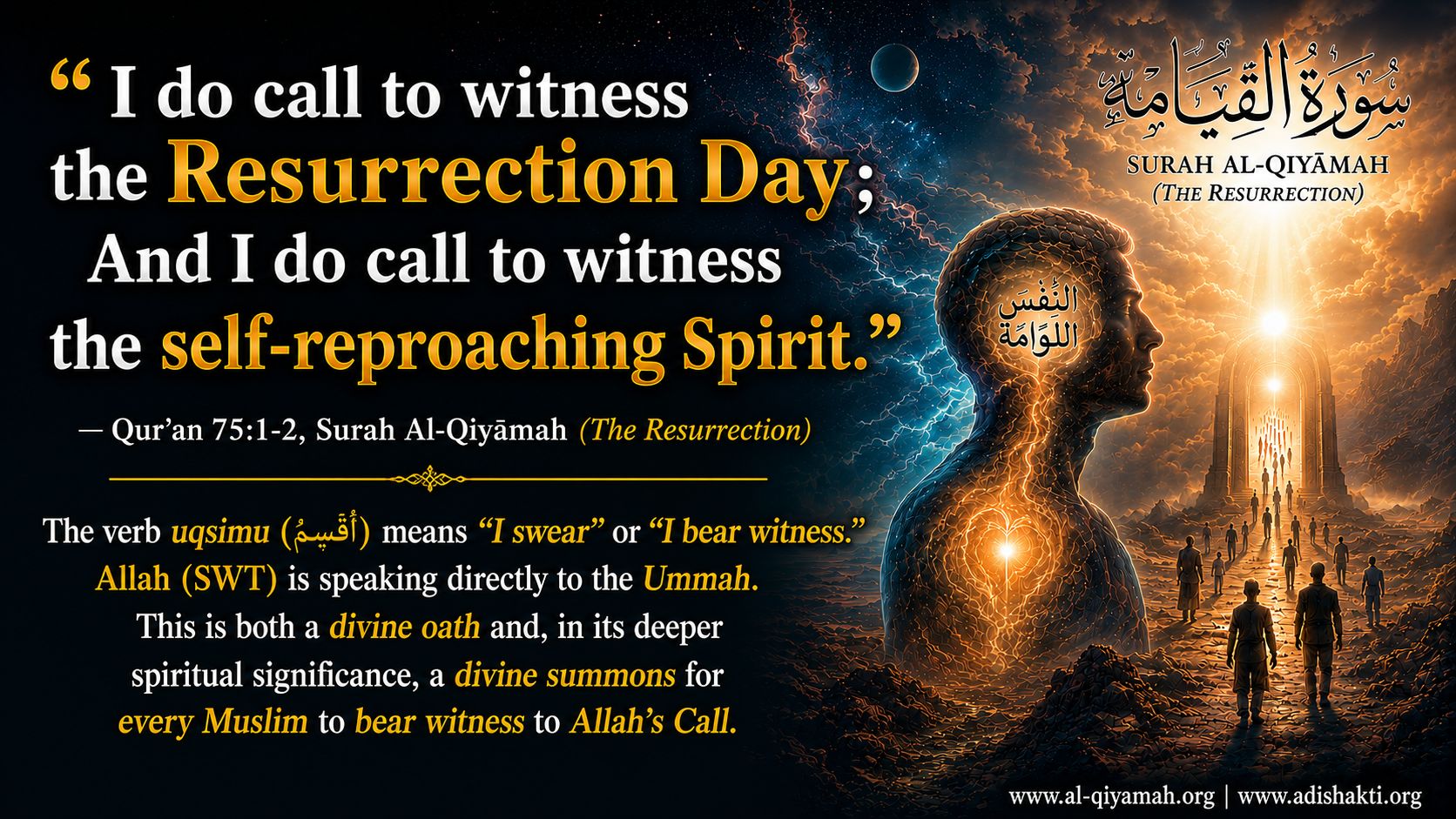
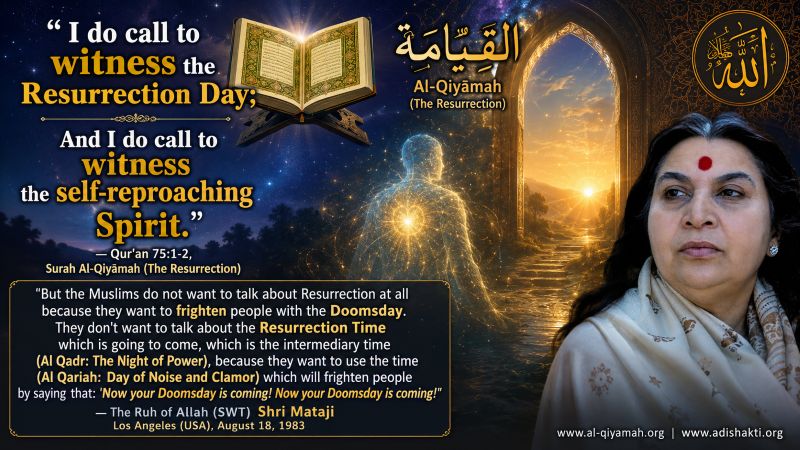
“I do call to witness the Resurrection Day; and I do call to witness the self-reproaching Spirit.” (Qur'an 75:1–2)
Al-Qiyāmah: The Resurrection Age — A Qur’an-Centered Study
Summary
Except for the theme of monotheism (Tawhīd), the Qur'an speaks more of the coming Al-Qiyāmah — also known as the Resurrection, the Day of Judgment, the Day of Gathering, and the Great Announcement — than of any other topic. Yet for fourteen centuries, the Ummah has been conditioned to expect a cataclysmic, physical end of the world. This comprehensive study demonstrates that Al-Qiyāmah is not what the ulema and the Ummah have believed it to be. It is an epochal Resurrection Age — a continuous, ongoing spiritual awakening of the soul, the realization of the self-reproaching spirit (An-Nafs Al-Lawwāmah), and the inner resurrection into eternal life. The Ummah's centuries-long indoctrination in a purely literalist, catastrophic eschatology is the fulfillment of Iblis's own promise to mislead humanity — permitted by Allah (SWT) as a trial for the arrogant. The Qur'an itself, in Surah 78:1-5, foretells this bitter division over the Great News and declares with double emphasis: kallā saya'lamūn, thumma kallā saya'lamūn — "Verily, they shall soon come to know! Verily, verily they shall soon come to know!"
CONTENTS
- Introduction: The Centrality and the Crisis
- The Linguistic and Theological Meaning of Al-Qiyāmah
- Surah Al-Qiyāmah (75): Complete Verse-by-Verse Exegesis
- The Fourteen Sure Signs of Al-Qiyāmah in the Qur'an
- The Multi-Dimensional Theology of Resurrection
- The Rūḥ (Spirit) and the Inner Resurrection
- The Deception of Iblis: How the Ummah Was Misled
- An-Naba (78:1-5): The Great News and the Division of Humanity
- Classical Tafsīr and Its Admitted Limitations
- The Hadith-Based Eschatology: A Critical Examination
- Compilation, Proclamation, and Exegesis: Allah's Command to Witness
- Conclusion: Surrendering to the Divine Reality
- References
1. Introduction: The Centrality and the Crisis
The paper opens by challenging a solely catastrophic reading of Al-Qiyāmah and presenting Resurrection as an epochal spiritual awakening.
Except for the theme of monotheism (Tawhīd), the Qur'an speaks more of the coming Al-Qiyāmah — also known as the Resurrection, the Day of Judgment, the Day of Gathering, and the Great Announcement — than of any other topic. Confessing the Shahādah and believing in the accountability of all humans before God holds Islam together.[1] Prophet Muhammad (pbuh) earnestly proclaimed as inevitable a day when truth would be known, when the thoughts and intentions of the heart would be revealed, and when accounts would be settled and scales would be balanced.
Fazlur Rahman, in an oblique paraphrase of Surah 50:22, said that Judgment Day is the "Hour when every human will be shaken into a unique and unprecedented self-awareness of his deeds; he will squarely and starkly face his own doings, not-doings, and mis-doings and accept the judgment upon them." Something like a Final Judgment or Day of Reckoning is a natural corollary of monotheism. If there is one God who knows all and sets standards of behavior for the world, there must be a time of judgment, or the edifice crumbles of its own weight.[2]
Hundreds of interpreters have written commentaries on it during the 14 centuries of its existence, and none have claimed to understand all of its various aspects and meanings. As a result of their admitted shortcomings and apparent incomprehension, the scattered verses relating to Al-Qiyāmah have been disfigured beyond recognition by mistranslations that reflect the views of the ulema.[3] This study compels Muslims not to allow themselves to pick and choose verses that suit their doomsday notion of Al-Qiyāmah. Rather, we must take the Qur'an in its entirety and examine those resurrection-related surahs that have challenged our scholars over the centuries.
2. The Linguistic and Theological Meaning of Al-Qiyāmah
The linguistic root of Al-Qiyāmah (القيامة) is qāma (قام), which means "to stand," "to arise," "to awaken," or "to be established." While traditionally translated merely as the Resurrection on the Last Day, its root implies an active, ongoing rising into the Divine Presence. The noun Qiyāmah is derived from the verbal noun qiyām, meaning "the act of standing" or "the state of being upright." This is not a passive event that happens to humanity; it is an active arising, a standing up in accountability and awareness before the Divine.
The Qur'an employs various terminology to describe this multidimensional reality, each highlighting a different dimension of the same profound truth:
| Arabic Term | Meaning | Primary Reference | Theological Implication |
|---|---|---|---|
| Al-Qiyāmah (القيامة) | The Resurrection / The Standing | Surah 75 | The awakening of the soul and standing in divine awareness. |
| As-Sā'ah (الساعة) | The Hour | Qur'an 22:7; 40:59 | The specific appointed time of reckoning and transformation. |
| Al-Ba'th (البعث) | The Raising / Awakening | Qur'an 22:5-7 | Being brought to life from spiritual or physical death. |
| Al-Ḥashr (الحشر) | The Gathering | Qur'an 50:44 | The assembly of all souls before the Divine. |
| An-Nushūr (النشور) | The Spreading Forth | Qur'an 67:15 | The spreading of souls after death for judgment. |
| Al-Wāqi'ah (الواقعة) | The Inevitable Event | Surah 56 | The certainty and inevitability of the Resurrection. |
| Al-Ākhirah (الآخرة) | The Hereafter | Throughout the Qur'an | The final abode and ultimate reality beyond this life. |
| An-Naba' al-'Aẓīm (النبأ العظيم) | The Great News | Qur'an 78:1-5 | The momentous announcement of the Resurrection Age. |
Belief in the Last Day is constantly paired with belief in Allah throughout the Qur'an. This pairing is not accidental; it is theologically essential. Without accountability, monotheism loses its moral force. The Resurrection is the foundation upon which the entire ethical edifice of Islam rests. Nearly every prophet warned of it — Noah, Abraham, Moses, Jesus, and Muhammad (peace be upon them all) — because it is the cornerstone of divine justice. The Day that Cannot Be Doubted is affirmed with absolute certainty:
3. Surah Al-Qiyāmah (75): Complete Verse-by-Verse Exegesis
The opening double oath anchors the paper’s argument concerning Resurrection and the self-reproaching soul.
Of all the chapters in the Qur'an, Surah 75 Al-Qiyāmah (The Resurrection) must have clearly confronted the scholars with so frightening a prophecy and promise of Divine intervention to collect, promulgate, recite, and explain in detail the only Surah entirely devoted to Al-Qiyāmah, that it could only be explained away by vagueness, briefness, distortion, misinformation, untruth, and outright deceit.[4]
3.1 The Divine Oath (75:1-2): The Epochal Witness
The classical commentators, including Ibn Kathīr, explained that the word lā (لا) before the oath is an emphatic particle, not a negation — meaning “Nay! I swear by the Day of Resurrection.” This is Allah (SWT) Himself bearing witness — and simultaneously commanding the Muslims and all of humanity to bear witness alongside Him — to two profound realities taking place: the Day of Resurrection and the self-reproaching spirit within every human soul. The divine oath is not merely a declaration; it is a summons. Allah bears witness, and He orders humanity to bear witness with Him.[5]
The Arabic construction of the oath in 75:1-2 demands close attention. The verb uqsimu (أُقْسِمُ) means “I swear” or “I bear witness.” Allah (SWT) is the one speaking. This is simultaneously a divine oath and a divine command to humanity. When Allah says “I bear witness to the Day of Resurrection” and “I bear witness to the self-reproaching spirit,” He is doing two things at once: He is Himself bearing witness — establishing the absolute certainty of these two realities by His own divine testimony — and He is commanding the believers, and all of humanity, to likewise bear witness to these same two realities: to acknowledge that the Day of Resurrection is taking place, and to acknowledge the self-reproaching spirit within their own souls as the living proof of that ongoing Resurrection.
This reading is entirely consistent with the Qur’anic usage of the oath form as both a divine declaration and an implied imperative to the listener. Allah does not swear by something merely to inform — He swears to compel recognition, to demand witness, to call humanity to testify alongside Him.
The Deeper Implication for Al-Qiyāmah
This interpretation carries a stunning implication that goes to the very heart of this paper’s argument: the opening verses of Surah Al-Qiyāmah are not merely a statement about the future — they are a divine summons to every human soul to bear witness to the Resurrection Age as it unfolds. Allah is saying: I am bearing witness — and I am ordering you to bear witness with Me. The self-reproaching spirit within you is already testifying. The question is whether you will listen to it, acknowledge it, and surrender to what it reveals.
This is precisely why the Ummah’s refusal to recognize the signs of the Resurrection Age is so grave — they are refusing a direct divine command to bear witness, issued in the very opening breath of the only Surah entirely devoted to Al-Qiyāmah.
The critical theological insight that has been missed for fourteen centuries is this: Allah does not swear by that which is distant or uncertain, but by that which is immediate, certain, and already manifesting. The self-reproaching spirit (An-Nafs Al-Lawwāmah) is not a faculty that is activated only on the Last Day. It is the inner moral compass, the conscience that awakens within the human soul now, in this life, in every moment of moral reckoning. This awakening is the very engine of the Resurrection Age.
Al-Ḥasan al-Baṣrī, one of the greatest of the early scholars, said of An-Nafs Al-Lawwāmah: "Verily, by Allah, we think that every believer blames himself. He says (questioning himself): What did I intend by my statement? What did I intend by my eating? What did I intend in what I said to myself? However, the sinner proceeds ahead and he does not blame himself."[6] This is the Resurrection operating within the living soul — not awaiting the grave.
3.2 The Reassembling of Bones and Fingertips (75:3-4)
The mention of fingertips is not incidental. Modern science has confirmed that fingerprints are unique to every individual — a fact unknown in the 7th century. This is one of the Qur'an's miraculous signs (āyāt) within the human body itself, confirming that Allah's power of re-creation extends to the most minute detail of human individuality. The Resurrection is not a vague, collective event; it is a precise, individual reckoning of every unique soul.
3.3 Man's Denial and the Question of the Hour (75:5-6)
Ibn 'Abbās explained that man's question "When will be this Day of Resurrection?" is not a genuine inquiry but a question of denial — he asks in mockery, refusing to accept the reality of accountability. This is the condition of the Ummah today: asking "When?" while the Resurrection Age has already commenced. They look for a distant, dramatic event while the signs manifest within their own souls and in the regions of the earth around them.
3.4 The Sun and Moon Joined Together (75:7-10)
The "joining" of the sun and moon is a solar eclipse — a natural, observable, recurring astronomical event. This is not a description of the end of the universe; it is a sign that the Day of Resurrection has a set time and that its portents are visible in nature. The dazed sight and the cry "Where is the refuge?" describe the spiritual disorientation of those who, when confronted with the truth of the Resurrection Age, find no escape from accountability.
3.5 No Refuge, Only Reckoning (75:11-15)
The phrase "man will be well informed about himself" (bal al-insānu 'alā nafsihi baṣīrah) is one of the most psychologically penetrating statements in all of scripture. Man is his own witness. The inner knowing — the conscience — testifies against the self even as the self attempts to make excuses. This is the An-Nafs Al-Lawwāmah in action: the self-reproaching spirit that is the very witness of the Resurrection Age.
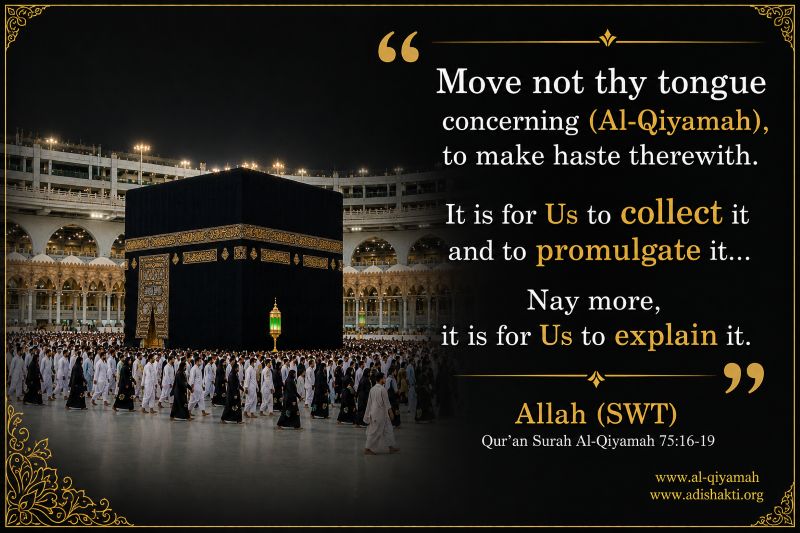
3.6 The Divine Promise to Collect, Promulgate, and Explain (75:16-19)
This passage is the most critical and most ignored in the entire Qur'an. Allah (SWT) has taken sole responsibility for collecting, promulgating, and explaining the verses of Al-Qiyāmah. This is not the work of human scholars or religious institutions — it is the direct intervention of the Divine.[7] No human scholar, no imām, no mufassir, however learned, has been granted the authority to definitively explain the full reality of Al-Qiyāmah. That authority belongs to Allah alone, and He will exercise it in His appointed time. Yet for 1,400 years, mortals with puny minds and huge egos have blabbed their tongues about this Surah, usurping Allah's prerogative and plunging the Ummah into darkness.
3.7 The Love of the Fleeting World (75:20-21)
This is the diagnosis of the human condition that perpetuates the blindness to the Resurrection Age. The love of the immediate, the fleeting, the material — this is what prevents the Ummah from recognizing the signs of the Resurrection that are unfolding before their eyes. They are too attached to their inherited interpretations, their institutional authority, and their comfortable certainties to accept the living reality of the Resurrection Age.
3.8 The Faces of the Believers and Disbelievers (75:22-25)
The faces of those who believe that Al-Qiyāmah has commenced will be nāḍirah (shining and radiant), looking towards their Lord. Those of disbelievers will be bāsirah (dark, gloomy, sad, and frowning). This is not merely a description of a future state; it is the visible reality of the present moment. The spiritual radiance of those who have experienced the inner resurrection is a tangible, observable sign of the Resurrection Age.
3.9 Death and the Soul's Departure (75:26-30)
This passage describes the moment of physical death with extraordinary precision — the soul rising to the collarbone, the desperate cry for a healer, the recognition that this is the final parting. The "joining of the legs" is understood by classical commentators as the wrapping of the body in its shroud. But the deeper meaning is the joining of the worldly and spiritual dimensions at the moment of death — the ultimate reckoning that every soul must face.
3.10 Rejection and Arrogance of the Disbelievers (75:31-35)
The fourfold "Woe to thee!" is among the most severe warnings in the Qur'an. It is directed at those who reject the Truth and turn away in conceit — precisely the behavior of those who, when confronted with the evidence of the Resurrection Age, "stalk to their family in full conceit," dismissing the divine signs with arrogance. This is the behavior of those religious authorities who, having admitted their incomprehension of the resurrection-related surahs, nevertheless continue to impose their limited understanding upon the faithful.
3.11 Is Resurrection Beyond the Creator? (75:36-40)
The Surah closes with an irrefutable argument: the God who created life from a drop of fluid is certainly capable of recreating it. The power of the Creator to "give life to the dead" is not limited to the physical resurrection of bones; it encompasses the spiritual resurrection of dead hearts, dead souls, and dead communities. This is the final, unanswerable challenge to those who doubt the Resurrection in any of its dimensions.
4. The Fourteen Sure Signs of Al-Qiyāmah in the Qur'an
The Sure Signs and descriptions of Al-Qiyāmah in the Qur'an are generally agreeable as follows, drawn from the comprehensive research.[8]
| # | Sure Sign | Qur'anic Evidence |
|---|---|---|
| 1 | There is a set time for it. | Qur'an 75:6-10 |
| 2 | This event is inevitable. | Qur'an 11:102-7 |
| 3 | The verses revealing Al-Qiyāmah will be collected, promulgated, recited, and explained by Allah. | Qur'an 75:16-19 |
| 4 | Prophesied Sure Signs of Allah will confirm Al-Qiyāmah. | Qur'an 41:53 |
| 5 | The Qur'an will be used as Allah's Warning to humankind. | Qur'an 50:45 |
| 6 | Allah will not address those who veil His Revelations by distorting the Qur'an. | Qur'an 2:174-6 |
| 7 | The messengers of Allah on Earth will deliver Good News of Al-Qiyāmah, and they must prevail. | Qur'an 58:21 |
| 8 | Believers will be bitterly divided over the Good News. | Qur'an 78:1-5 |
| 9 | Jesus (pbuh) would be one of the Signs of the Hour. | Qur'an 43:61 |
| 10 | The Qur'an will be used as proof of authenticity to humankind regarding the Message of Al-Qiyāmah. | Qur'an 21:106-7 |
| 11 | There will be a Caller from a place quite near who will declare and commence the Resurrection. | Qur'an 50:37-42 |
| 12 | Many humans will be unaware that Al-Qiyāmah is taking place. | Qur'an 30:55-57 |
| 13 | Allah will not purify those who hide His Revelations by misinterpreting the Qur'an. | Qur'an 2:174-6 |
| 14 | Faces of believers will be nāḍirah (shining), while those of disbelievers will be bāsirah (dark and gloomy). | Qur'an 75:22-24 |
Despite all the above, the Qur'an warns that most humans will neither be aware nor believe that this Great Event is taking place, even after being warned that it is not about graves opening up but of all souls born again to participate in it:
5. The Multi-Dimensional Theology of Resurrection in the Qur'an
A comprehensive reading of the Qur'an reveals that the Resurrection is not a single event but a progressive, multi-dimensional theology that moves through successive stages. The Qur'an repeatedly uses resurrection imagery in multiple contexts while also preserving the central doctrine of the final resurrection before God.[9]
5.1 The Resurrection of Nature and the Earth
The Arabic word al-nushūr (النشور) — "the Resurrection" — is used here in direct analogy with the revival of dead earth by rain. This is not merely a metaphor; it is a theological statement that the same divine power that brings life to dead earth brings life to dead souls. The Resurrection is a pattern woven into the fabric of creation itself.
5.2 The Resurrection of the Heart
These passages describe a spiritual resurrection that occurs in this life — the awakening of the dead heart to divine reality, the transition from spiritual death to spiritual life. This is the inner resurrection that the Sufi tradition has always recognized, and which the mainstream ulema have systematically marginalized in their obsession with the physical, external, future event.
5.3 The Three Stages of the Soul (Nafs)
The Qur'an describes three stages of the soul (nafs), each representing a different level of spiritual development and, correspondingly, a different level of resurrection:
| Stage of Nafs | Arabic Term | Qur'anic Reference | Spiritual State |
|---|---|---|---|
| The Commanding Self | Nafs al-Ammārah | Qur'an 12:53 | Dominated by ego and desire; spiritually dead. |
| The Self-Reproaching Self | Nafs al-Lawwāmah | Qur'an 75:2 | Awakening conscience; the beginning of inner resurrection. |
| The Tranquil Self | Nafs al-Muṭma'innah | Qur'an 89:27-30 | At peace with the Divine; fully resurrected in spirit. |
The journey from Nafs al-Ammārah to Nafs al-Muṭma'innah is the inner resurrection. It is the journey from spiritual death to spiritual life, from the domination of the ego to the peace of the Divine. The Qur'an's oath by An-Nafs Al-Lawwāmah in 75:2 is precisely because this stage — the awakening of the self-reproaching conscience — is the pivotal moment of the inner resurrection.
6. The Rūḥ (Spirit) and the Inner Resurrection
Placed beside the paper’s discussion of the Rūḥ and its interpretation of Allah’s promise to collect, recite, and explain.
6.1 The Divine Breath and the Creation of Adam
The phrase "of My Spirit" (min rūḥī) is extraordinary. Allah (SWT) does not say "a spirit" or "the spirit" — He says "of My Spirit," indicating a direct divine connection between the human soul and the Divine Being. This divine spark within every human being is the basis of the inner resurrection. When this divine spark is awakened — when the Rūḥ is recognized and experienced — the inner resurrection occurs.
The Rūḥ (Spirit) is the most profound mystery in the Qur'an. Allah (SWT) has communicated only a little of its knowledge to humanity. This is not a statement of permanent ignorance; it is a statement of the limits of human knowledge at a given time. The Resurrection of the Spirit is the reconnection of the individual soul with the Universal Spirit — the ultimate inner resurrection.
6.2 The Night of Power and the Descent of the Rūḥ
The Night of Power and Fate — Laylat al-Qadr — is the blessed night when divine decree flows from the heavens to earth, when angels descend with the Holy Spirit (Rūḥ), when peace reigns until dawn. This marks the beginning of the Resurrection. It is the gentle opening of the cosmic door before the thunderous arrival of Al-Qāri'ah — the Day of Noise and Clamour.
6.3 The Caller from Within (Qur'an 50:37-42)
The Caller from "a place quite near" (makānin qarīb) is one of the most significant prophecies regarding Al-Qiyāmah. The place "quite near" is not a geographical location — it is the place within the human heart where the self-reproaching Spirit resides. The mighty Blast in Truth is the awakening of consciousness that occurs when the divine Spirit within is recognized and experienced.
6.4 Jesus (pbuh) as a Sign of the Hour (Qur'an 43:61)
Jesus (pbuh) is explicitly described as a sign ('ilm) of the Hour. The traditional interpretation holds that this refers to Jesus's physical return at the end of times. But the deeper dimension is that Jesus — who raised the dead, gave sight to the blind, and breathed life into clay birds — is the supreme symbol of the inner resurrection. His entire ministry was a demonstration of the power of the Spirit to resurrect the spiritually dead. His role in Islamic eschatology is not merely as a warrior who kills the Antichrist; it is as the sign of the spiritual resurrection that the Hour brings.
7. The Deception of Iblis: How the Ummah Was Misled
7.1 Iblis's Promise to Mislead
7.2 The Mechanism of Deception
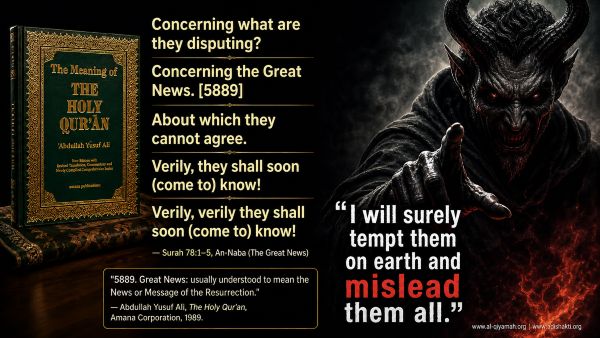
How has Iblis accomplished this deception? By engineering a system where Allah's truth is rejected in the very name of defending faith from Iblis. The Ummah, in a state of profound misguidance, now uses its own scripture to fight against its fulfillment, thereby making Iblis's promise a self-replicating, self-fulfilling prophecy.[10] The mechanism is elegant in its diabolical simplicity:
- Iblis convinces the ulema that Al-Qiyāmah is exclusively a future physical event of cosmic destruction.
- The ulema encode this interpretation into the tradition, making it the orthodox position.
- Any evidence of the present, spiritual Resurrection Age is dismissed as innovation (bid'ah) or deception.
- The Ummah waits for a physical event that has not yet come, while the spiritual Resurrection Age unfolds around them unrecognized.
- They fulfill the prophecy of Qur'an 30:55-57: "This is the Day of Resurrection, but ye used not to know."
7.3 The Warning of the Prophet (pbuh)
7.4 Allah's Warning to Those Who Conceal His Revelations
This verse is not speaking of some distant future — it describes the present reality. Allah (SWT) will not address those who have veiled His revelations about the Resurrection. They have chosen the fleeting profits of religious authority over the eternal truth of divine guidance. They have sold the birthright of the Ummah for the temporary satisfaction of maintaining their positions of power.
8. An-Naba (78:1-5): The Great News and the Division of Humanity
The Great News of Surah 78:1–5 is integrated into the paper as a key Resurrection announcement over which humanity disputes.
Abdullah Yusuf Ali noted in his commentary: "Great News: usually understood to mean the News or Message of the Resurrection."[12] The double repetition of "Verily, they shall soon come to know!" — kallā saya'lamūn, thumma kallā saya'lamūn — is among the most emphatic warnings in the entire Qur'an. The repetition is not mere literary emphasis; it is a divine insistence that this knowledge will come, whether the disputants accept it or not.
The Qur'an describes the believers as "bitterly divided" over the Great News. This division is not accidental — it is the inevitable result of approaching the Resurrection with the mind rather than the heart, with scholarship rather than surrender, with tradition rather than truth.
| The Traditional View | The Qur'an-Centered View |
|---|---|
| Al-Qiyāmah is a singular, future, physical event of cosmic destruction. | Al-Qiyāmah is an epochal Resurrection Age that has already begun. |
| The signs are external, dramatic, and supernatural (Dajjāl, Mahdī, physical Jesus). | The signs are within human souls and in the regions of the earth (Qur'an 41:53). |
| The Resurrection is about graves opening and bodies rising. | The Resurrection is about souls awakening and spirits being reborn. |
| The ulema are the authoritative interpreters of Al-Qiyāmah. | Allah (SWT) alone has the authority to explain Al-Qiyāmah (Qur'an 75:19). |
| The Hadith is the primary source for understanding the signs of the Hour. | The Qur'an alone is the authoritative source for the signs of Al-Qiyāmah. |
9. Classical Tafsīr and Its Admitted Limitations
Abdullah Yusuf Ali's The Holy Qur'an: Text, Translation and Commentary — by far the most known, studied, and respected English translation of the Qur'an — devotes only five pages (inclusive of the entire text in Arabic and its English translation) to this central theme of Islam.[13] And other Muslim scholars have done no better, although they have produced countless theses on far pettier topics and hadiths. According to Professor Mahmoud M. Ayoub, "Theology has confused the rank and file of Muslims. It has discouraged any kind of innovative thinking. It has paralyzed the intellectuals, preoccupying them with unsolvable questions."[14]
| Scholar | Period | Position on Al-Qiyāmah | Limitation |
|---|---|---|---|
| al-Ṭabarī (839-923 CE) | Early Abbasid | Comprehensive physical resurrection; detailed eschatological events. | Primarily relied on isrā'īliyyāt to fill gaps in Qur'anic description. |
| Ibn Kathīr (1301-1373 CE) | Mamluk | Literal, physical resurrection; extensive use of hadith. | Admitted that the full meaning of resurrection-related verses is known only to Allah. |
| al-Qurṭubī (1214-1273 CE) | Andalusian | Detailed eschatological commentary; acknowledged multiple levels of meaning. | Focused primarily on legal and theological implications rather than spiritual dimensions. |
| Fakhr al-Dīn al-Rāzī (1149-1209 CE) | Medieval | Philosophical approach; engaged with rational arguments for resurrection. | Philosophical framework sometimes obscured the direct Qur'anic message. |
| al-Ghazālī (1058-1111 CE) | Seljuk | Integrated physical and spiritual resurrection; emphasized inner transformation. | Sufi insights were often marginalized by mainstream scholarship. |
| Ibn Taymiyyah (1263-1328 CE) | Mamluk | Strict literal interpretation; rejected allegorical readings. | Rigidity prevented engagement with the spiritual dimensions of resurrection. |
The Islamic mystical tradition (taṣawwuf) has always recognized the inner dimension of the Resurrection. The famous saying attributed to the Prophet (pbuh) — "Die before you die" — encapsulates the Sufi understanding of the inner resurrection. This is the death of the ego (fanā') and the resurrection of the spirit (baqā') — the annihilation of the false self and the resurrection of the true self in divine awareness. Al-Ghazālī, in his Iḥyā' 'Ulūm al-Dīn (The Revival of the Religious Sciences), described the inner resurrection as the awakening of the heart from its spiritual death — the death of heedlessness (ghafla) — to the life of divine awareness.
10. The Hadith-Based Eschatology: A Critical Examination
The hadith-based signs of Qiyāmah have played a significant role in shaping the eschatological beliefs of the Muslim world. The Qur'an-centered approach argues that the true signs of Qiyāmah are to be found exclusively within the verses of the Holy Qur'an, and that any hadith that contradicts the Qur'an must be rejected.[15]
| Category | Hadith-Based Sign | Source |
|---|---|---|
| Social Decay | Knowledge is taken away; ignorance prevails. | Sahih Bukhari, Vol. 1, Book 3: 80 |
| Social Decay | Wide consumption of wine (intoxicants). | Sahih Bukhari, Vol. 1, Book 3: 80 |
| Social Decay | Widespread zinā (fornication/adultery). | Sahih Bukhari, Vol. 1, Book 3: 80 |
| Natural Signs | Increase in earthquakes. | Sahih Bukhari, Vol. 2, Book 17: 146 |
| Natural Signs | The sun rises from the west. | Sahih Bukhari, Vol. 6, Book 60: 159 |
| Major Signs | The Mahdī (the Guided One) will appear as Imam of the Muslims. | Sunan Abu Dawud, Book 36: 4272 |
| Major Signs | Jesus ('Īsā) will descend in Damascus and pray behind the Mahdī. | Sahih Bukhari, Vol. 3, Book 43: 656 |
| Major Signs | The Antichrist (al-masīḥ al-dajjāl) appears with vast deception. | Sahih Muslim, Book 41: 7034 |
| Major Signs | Appearance of Gog and Magog (Ya'jūj wa Ma'jūj). | Sahih Muslim, Book 41: 6931 |
| Major Signs | The blowing of the Trumpet by Isrāfīl (first blowing: fainting; second: resurrection). | Sahih Muslim, Book 41: 7023 |
The central pillar of the Qur'an-centered critique is Surah Al-Qiyāmah (75), which is dedicated entirely to the theme of the Resurrection. The divine promise in 75:16-19 that Allah (SWT) Himself will collect, promulgate, and explain the verses of Al-Qiyāmah is interpreted as a direct command to rely solely on the Qur'an for knowledge of the Resurrection. Furthermore, the Qur'an warns explicitly against those who "conceal Allah's revelations in the Book" (2:174-6) and those who are "arrogant upon the earth without right" (7:146). The hadith-based eschatology, with its dramatic, external, and often politically convenient signs, serves the interests of religious authority far better than the Qur'an's call for inner awakening and spiritual accountability.
Compilation, Proclamation, and Exegesis of Surahs Upholding Allah’s (SWT) Command to His Ummah — to Witness and Participate in the Resurrection.
Al-Qiyamah: A Profound Declaration of Al-QiyamahAl-Qiyamah (75:1-2): Oaths of Resurrection Al-Qiyamah (75:3-4): Reassembling Bones and Fingertips
Al-Qiyamah (75:5-6): Man's Denial of Resurrection
Al-Qiyamah (75:7–10): Sun and Moon 'Joined' At Solar Eclipse
Al-Qiyamah (75:7–10): Solar Eclipse Salat al-Kusuf
Al-Qiyamah (75:11–13): No Refuge, Only Reckoning
Al-Qiyamah (75:14–15): Man: His Own Witness and Judge
Al-Qiyamah (75:16–19): The Usurpation of Allah's Explanation
Al-Qiyamah (75:20–21): Love of The Fleeting World
Al-Qiyamah (75:22–25): Ruh’s Face Brings Either Glory Or Gloom
Al-Qiyamah (75:26–30): Death and Soul's Departure Home
Al-Qiyamah (75:31–35): The Rejection and Arrogance of the Kuffar
Al-Qiyamah (75:36–40): Is Resurrection Beyond Allah, Your Creator?
Al-Qiyamah (75:1-2 and 78:1–5): An Naba and Oaths of Resurrection
Al-Baqarah (2:138): Baptism of Allah You Were Unaware Of
Al-Baqarah (2:174): Allah Will Not Address Muslims
Al-A'raf (7:16) – Iblis: I Will Lie In Wait and Overpower Them
Al-A'raf (7:146): Allah: I Will Turn Them Away From My Signs
Al-A'raf (7:146): Allah: So Even Though They See All The Signs
Al-Hijr (15:39) – Iblis: I Will Wake (Evil) Fair and Mislead Them
An-Nahl (16:2) – Allah (SWT) Sent Down Angels With His Ruh
Al-Isra (17:85): Muslims Given Little of Allah's (SWT) Ruh
Al-Isra (17:104): Children of Israel Gathered Again (in 1948)
Al-Isra (17:104): Shaykh Palazzi: Children of Israel
Al-Hajj (22:8) – Kitab Al-Munir You Were Unaware Of
Al-Rum (30:56) – The Day of Qiyamah You Were Unaware Of
Fatir (35:9) – Winds of Qiyamah You Were Unaware Of
Yassin (36:63-68) – This Is The Hell You Were Warned Of.
Sad (38:79) – Iblis Allowed to Mislead Muslims And He Did
Fussilat (41:20–21) – Your Hands Will Testify of Qiyamah
Fussilat (41:53) – We Will Show Our Signs Within Your Soul
Az-Zukhruf (43:61): Jesus, Sign of Hour You Were Unaware
Az-Zukhruf (43:62): Satan's Deception of the Muslim Ummah
Az-Jathiya (45:7-14) – Those Who Deny Allah's Revelations
Qaf (50:41) – Listen To The Caller Emerging From Within
Qaf (50:42) – Day They Will Hear of Mighty Blast Witnessed
Qaf (50:45) – By the Caller, My Warning Is Delivered
Al Dhariyat (51:20-22) – Our Signs on Earth and Within
Al-Hadid (57:25) – Allah's (SWT) Iron Has Been Delivered
Al-Mujadilah (58:21) – My Messengers Must Prevail
Al-Saff (61:8–9) – Revelation of Light You Were Unaware
Al-Muddaththir (74:1–2) – My Cloaked One: Deliver Warning
Al-Mursalat (77:1–10): Angels Sent You Were Unaware Of
An-Naba (78:1–5): Concerning What Are They Disputing?
Al-Infitar (82:17–18) – What Will Explain To You? What Will?
Al-Mutaffifin (83:1–6) – Dealers in Fraud You Were Unaware
Al-Tariq (86:1–3) – The Night Visitant You Were Unaware
Al-Qadr (97:1–5) – Blessed Night of Power and Fate Before:
Al-Qariah (101:1–11) – Terrifying Day of Noise and Clamour
This compilation represents the divine architecture of Al-Qiyāmah as revealed throughout the Qur'an. Together, these passages form an overwhelming, irrefutable testimony that Al-Qiyāmah is not a single future event but a comprehensive, ongoing divine reality that encompasses every dimension of human existence — physical, spiritual, social, and cosmic.
11.1 The Universal Expectation of the Mahdī (Messiah, Comforter)
There is a universal expectation across all religious traditions of a Savior who will come at the time of the Last Judgment to save the world. "The Mahdī, according to Islam, and in particular its Shiite branch, is the Savior to come at the time of the Last Judgment to save the world. It is interesting to recall that Mahdī, in Sanskrit, is the contraction of Ma Adi (Primordial Mother) in the same way that the returning Savior according to Buddha, Maitreya, is a contraction of Ma Treya (Trigunatmika). The function of the Mahdī is similar to those attributed to the Kalki of the Hindus, the Maitreya of the Buddhists, or the Paraclete-Holy Spirit of the Christians."[16]
11.2 The Return of the Children of Israel
The gathering of the Children of Israel in the Holy Land — accomplished in 1948 with the establishment of the State of Israel — is a fulfillment of this Qur'anic prophecy. The Ummah continues to wait for signs that have already been fulfilled, while the Resurrection Age unfolds before their eyes.
11.3 The Messengers Must Prevail
The messengers of Allah (SWT) on Earth will deliver the Good News of Al-Qiyāmah, and they must prevail. This is a divine decree — not a hope or a possibility, but a certainty. Those who deliver the message of the Resurrection Age, who challenge the ulema's distortions and call the Ummah back to the living truth of the Qur'an, are fulfilling this divine command. Their message will prevail, regardless of the opposition they face.
12. Conclusion: Surrendering to the Divine Reality
This comprehensive, Qur'an-centered academic study has demonstrated that Al-Qiyāmah is not what the ulema and the Ummah have believed it to be for centuries. The evidence of the Qur'an itself — taken in its entirety, without the selective picking and choosing that has characterized centuries of traditional scholarship — points overwhelmingly to a multi-dimensional, epochal Resurrection Age that encompasses both a present spiritual reality and a future physical culmination.
The traditional, literalist, catastrophic interpretation of Al-Qiyāmah has served as an interpretive prison, blinding the faithful to the signs manifesting within their own souls and in the regions of the earth around them. It has fulfilled the prophecy of Iblis — who promised to sit in wait on the Straight Path and mislead humanity — by engineering a system where Allah's living truth is rejected in the very name of defending faith.
The Qur'an's own testimony is clear and unambiguous:
- Allah (SWT) has taken responsibility for collecting, promulgating, and explaining Al-Qiyāmah (75:16-19).
- The signs of Al-Qiyāmah are within human souls and in the regions of the earth (41:53).
- Many humans will be unaware that Al-Qiyāmah is taking place (30:55-57).
- Believers will be bitterly divided over the Great News (78:1-5).
- Allah will not address those who conceal His revelations (2:174-6).
- The messengers of Allah must prevail (58:21).
References
[1] "Al-Qiyamah — The Resurrection." Adishakti.org. Accessed June 26, 2026.[2] Rahman, Fazlur. Major Themes of the Qur'an. University of Chicago Press, 1980. Paraphrase of Surah 50:22.
[3] "Al-Qiyamah: The Great News of Resurrection." Al-Qiyamah.org. Accessed June 26, 2026.
[4] "Surah Al-Qiyamah 75:16-19 — The Usurpation of Allah's Explanation." Adishakti.org. Accessed June 26, 2026.
[5] Ibn Kathīr, Ismā'īl ibn 'Umar. "Tafsīr Ibn Kathīr — Surah Al-Qiyamah (Chapter 75)." AbdurRahman.org. Originally composed 14th century CE.
[6] Al-Ḥasan al-Baṣrī, quoted in Ibn Kathīr. "Tafsīr of Surah Al-Qiyamah 75:2." AbdurRahman.org.
[7] "Surah Al-Qiyamah Ayahs 16-19." Quran.com. Accessed June 26, 2026.
[8] "Sure Signs of Day of Al-Qiyamah." Adishakti.org. Accessed June 26, 2026.
[9] "A More Original Academic Approach — Progressive Theology of Resurrection." Pasted Content 2, provided by user. June 26, 2026.
[10] "Iblis's Deception and Allah's Warning: A Theological Analysis." Pasted Content 3, provided by user. June 26, 2026.
[11] Ibn Babuya. Thawab ul-A'mal. Quoted in "Al-Qiyamah." Adishakti.org.
[12] Ali, Abdullah Yusuf. The Holy Qur'an: Text, Translation and Commentary. Amana Corporation, 1989. Note 5889 on Surah 78:1-5.
[13] "So Little Available Knowledge of Al-Qiyamah." Adishakti.org. Accessed June 26, 2026.
[14] Ayoub, Mahmoud M. Quoted in "Al-Qiyamah." Adishakti.org. Accessed June 26, 2026.
[15] "A Quran-Centered Approach to Eschatology: The Argument for True Signs." Pasted Content 3, provided by user. June 26, 2026.
[16] "The Universal Expectation of the Mahdi (Messiah, Comforter)." Adishakti.org. Accessed June 26, 2026.
عَمَّ يَتَسَاءَلُونَ - عَنِ النَّبَإِ الْعَظِيمِ - الَّذِي هُمْ فِيهِ مُخْتَلِفُونَ - كَلَّا سَيَعْلَمُونَ - ثُمَّ كَلَّا سَيَعْلَمُونَ
Concerning what are they disputing?
Concerning the Great News. [5889]
About which they cannot agree.
Verily, they shall soon (come to) know!
Verily, verily they shall soon (come to) know!
Surah 78:1-5 An-Naba (The Great News)
“5889. Great News: usually understood to mean the News or Message of the Resurrection.” Abdullah Yusuf Ali, The Holy Qur'n, Amana Corporation, 1989.